I've seen occasional confusion from people over the last few weeks "Why is it so cold, isn't it Spring now?" - and I thought I should say a bit about one of the major causes that I almost never hear people talk about - the polar vortex.
This is a swirling wind around the Arctic that exists for basically the whole arctic night. One of the things it does is keep the freezing polar winds from coming further south in to Europe. But when it finally collapses in the Spring, it finally allows those winds out, and you get a sudden burst of cold air as all of that freezing weather escapes down to us.
Normally this happens some time in late February, but this year the collapse seems to have been a month later.
The other major factor is largely down to circulating high pressure areas (imagine slow large hurricane shaped wind "objects") that constantly move around the North Atlantic. Put one of these off of the west coast of Ireland, going clockwise, and it will pull air down from the North even further/faster. See this short video I took from the NullSchool site (my favourite wind visualisation site). In it you can see cold winds pouring down from the North Pole, funneled further by the circulation. And if you click on the link there you can see that currently the wind is instead being pulled off of the Altantic, where it's a few degrees colder.
British weather tends to be more chaotic than the weather north or south of us. This is because Spain (for instance) is fairly reliably in the warm weather caused by the heating tropics. And Norway is fairly reliably cold, due to proximity to the North Pole. But Britain can be part of either weather system, as the "barrier" between them is pulled North or South by a few hundred miles depending on the movement of the high pressure areas in the eastern part of the North Atlantic, either funnelling the warm air up to us or channeling the cool air down to us.
You can see that at the moment the warm weather is being slowly blown North-East, now that the cold weather isn't pushing its way down to us:
So, next time we get a period of warm weather at the end of Winter/start of Spring followed by a sudden burst of freezing weather for a few days, that's the polar vortex collapsing. And if we suddenly go from warm weather to cold (or vice versa) it's because we've switched weather system.
I have an old classical guitar... old enough to vote for Carter... the strings are shot and the saddle (where the strings sit) is cracked but hey, new strings will make it sound better and play easier.
So I start to restring it and *crack*. Not just the saddle broke but the bridge broke too.
The saddle can be replaced. Just gluing the bridge back together is unlikely to work. It'll just snap off again. Removing the old saddle and gluing in a new one might not be worth the time and energy.
There's the other classical guitar I tried the fix and made a mess of, and there's an heirloom 'student' or 'parlor' guitar that really needs a new nut. That needs someone who knows what they're doing and I don't. It needs millimeter precision to make correct.
I don't mind repairing electric guitars - even shitty ones - they're more fun and interesting. Acoustics? Especially shitty cheap classical guitars? Nope.
I got a text this morning from Chase, asking me about a suspicious charge. I tried to log in to their website to look at it, but couldn't get them to send me a one-time code, so I went ahead and sent back "NO," telling them to cancel/replace the card in question. Now I'm going to have to update a _lot_ of recurring charges and stored payment methods.
So far I have had enough trouble finding my other credit card that I went ahead and gave Chewy a debit card for the auto ship order they're in the middle of processing. I then looked further back in the same drawer, found the other credit card, and put it in my wallet. I'm going to wait for the new card to arrive, and use it for most of the recurring charges, because I get slightly better points/cash back on purchases. But this is going to be tedious and time-consuming, and I will almost certainly forget at least one recurring charge.
I think I can make a list of the monthly charges by looking at last month's bill, at least.
Unless someone takes a picture and posts it on the internet, of course - and what are the odds of that?
Heheheh.
Heh.
Heh.
Hoo! Yeah. Good stuff.
Hey, maybe if we get a mirror!
Oh. Wait...
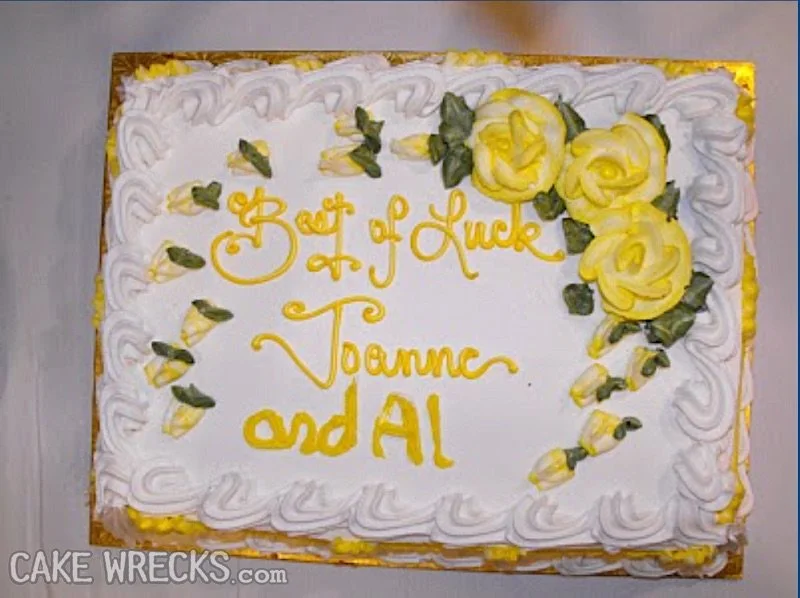
Don't worry, "Jett" - those poo-bats are so disturbing, no one will care whose cake this used to be.
How to make Al feel special:
AFTERTHOUGHTS: Technically they're still thoughts, and that's what counts.
And finally, how to totally freak out your boyfriend:
(No, this wasn't intentional. And yes, that's the store "fix.")
I can tell you that Isaiah was probably never happier to see a Cake Wreck in his entire life, though.
Andrea B., Michelle V., LG, Sharon H., & Ashley, you've gotta admit: that would be a great way to break the news. Much better than, say, putting the used pregnancy test stick on the cake.
******
P.S. My "related searches" kind of got away from me today, but I think you'll approve:
Annoyance #1: I apparently can't run my induction stove and my microwave at the same time without tripping the 20A circuit breaker that they share. What's weird is, I didn't even notice until it came time to nuke my lunch.
Annoyance #2: The manual that came for my stove is for a different model. I did eventually figure out how to set the clock after I reset the breaker. Yes, the clocks on my microwave, stove, and wall opposite them all tell the correct time because I'm so anal-retentive I can turn coal into diamonds with my butt.
Annoyance #3: This one was kind of a doozy. So, you may recall that my Mom's house finally sold late last summer, and we divvied up the cash. What you pay taxes on is sale price minus fair market value at the time of Mom's death – which is pretty much up to the ever-scrupulous Good Sister to decide – and some kinds of expenses incurred getting the house ready for sale.
Well, I never reported that income, or in this case, small loss. You see, I never got a 1099-S from the title company the way Good Sister did. Neither did Evil Sister, so I'm pretty sure I didn't throw it out by mistake. See "anal-retentive" above.
At GS's urging, I called up the title company in my hometown. They have a 1099-S for Evil Sister on file, but not mine. So now I have an electronic copy of ES's 1099-S so I can file an amended return. Mayyybe I could get an additional refund out of this, but the main point of filing more stuff is to keep the IRS off my back.
Speculation: since my 1099-S appears not to exist, the IRS doesn't know about all of this either, which was why they sent my refund so quickly. I'm sorely tempted to blow this off, but GS is firmly against that. Given that she's a CPA, she's probably right.
Current Mood:annoyed
Current Location:the living room of the Devil Girl House
War is hell. But war is also geometry. And geometry can be quite beautiful. Prime examples of that disturbing paradox are the so-called star forts that proliferated throughout Renaissance Europe.
Seen from above, these bastioned fortifications resemble elaborate ornamental diagrams, or perhaps even sacred mandalas. Yet their snowflake-like beauty was unintended. These were machines of war, developed from a mathematical attempt to solve a practical military problem: how to defend an army or a city from enemy artillery.
Typical star-shaped fortification from Jean Errard’s influential 1596 treatise. (Credit: Jean Errard, public domain)
Foundational to fortification theory was Jean Errard’s 1594 treatise La fortification réduicte en art et démonstrée, in which the French mathematician and engineer used geometry to formalize military architecture, helping to transform fort-building from a traditional craft into a discipline grounded in mathematics.
The resulting star forts (so called because of their multiple fortified extrusions) solved a technological crisis. Medieval fortresses, built to withstand ladders, catapults, and siege engines, were no match for gunpowder-powered artillery, the 15th century’s major military innovation. A cannon could easily take out vertical masonry walls that had stood unconquered for centuries.
Fort Bourtange, a fortified village in the Dutch province of Groningen. (Credit: Wikimedia Commons, CC BY-SA 3.0)
Military engineers resorted to building lower, thicker ramparts, backed by earth, and sought to eliminate blind spots by building angular bastions — the aforementioned extrusions. Star fortifications started in Italy, were perfected in France (especially by the prolific Vauban), and dominated the European military scene for the entire 17th and 18th centuries, giving Europe’s strategic cities and landscapes a distinctive architectural look.
Despite their sophistication, star forts eventually became obsolete, undone by the very problem they once solved. Technological advances such as explosive shells and rifled cannon greatly increased the range and destructive power of artillery, rendering their ramparts increasingly ineffective. Additionally, military strategy shifted away from static defenses toward highly mobile field armies.
The city of Nicosia on Cyprus, as it appeared in the late 16th century. The battlements are still visible in today’s urban grid – but the circle is now split in two: a Turkish north, and a Greek south. (Credit: Giacomo Franco, CC BY 2.0)
By the 19th century, star forts had lost their military purpose. Many were dismantled to let the cities they once protected grow beyond their historic walls. Ironically, once relieved from their purely militaristic duties, star forts revealed their aesthetic value. That is why many of these geometric landscape features were eventually preserved as monuments or converted into parks.
While the star fort’s aesthetic appeal is immaterial to its (erstwhile) military purpose, its beauty is not mysterious or accidental: It arises precisely from its strict adherence to geometric logic. Symmetry, repetition, and radial balance are powerfully pleasing principles in human perception. When military engineers pursued these features for practical purposes, they inadvertently produced structures that resonate with the same mathematical harmony as other Renaissance art and architecture.
Star fortifications were popular well beyond Europe. This is Fort Goryokaku, built in the mid-19th century in the northern Japanese city of Hakodate. Now a park, the fort is illuminated by thousands of lights from December to February. (Credit: Visit Hakodate)
We’re no longer designing star forts, but accidental beauty still emerges from rational design, be it airplanes, designed to be aerodynamic; bridges, engineered to last; and even digital networks, built for efficiency. When we optimize structures for functionality, the resulting forms often exhibit unexpected elegance.
Or, to summarize that in the fewest words possible: beauty is an emergent property of rational design. No-nonsense military builders like Errard and his ilk would no doubt have appreciated the pithiness of the phrase.
Built by the Venetians in the late 16th century, Palmanova has a double geometry: its interior consists of four nine-sided ring roads, following the idea in Thomas More’s Utopia that symmetry would help distribute knowledge and skills evenly throughout the city; and its exterior consists of two further encirclements, each with nine bastions. (Credit: European Space Imaging)
There was a lot of great content this week but one particularly moved me, and that's Cool People Who Did Cool Stuff's "If Not Us Than Who: The Russian Partisans at War Against Putin." (Part 1,Part 2).
My biggest disagreement with people who I'm otherwise in political lockstep with is Ukraine. Most (North American) leftists are wrong about this. I know this because I have actually been to Ukraine (and Russia), not just in touristy areas, and they for the most part haven't and don't know what they're talking about and are generally basing their opinions on either Cold War nostalgia, residual anti-imperialist trauma, or the appalling behaviour of some diaspora Ukrainian communities. My shitlib position is that you shouldn't invade other people's countries and kill them because you want their land or resources. Even if—and this is critical when we're talking about Palestine or Iran too—you don't like them and some of them are bad people. If that makes me a NATO stooge or CIA asset so be it.
Margaret and guest Charles McBryde share my opinion and also argue with other leftists about this, so you already know I'm going to agree with them. (Though not totally—we are all leftists here after all.) And you know who else does? A fuck of a lot of Russians. These two episodes focus on the frankly heroic actions of the Russian activists who resist Putin's authoritarianism, including Ruslan Siddiqui, who is genuinely cool not just for his political convictions but with the truly brass balls panache with which he acted. Margaret refers to him as the most cyberpunk guy she's ever heard of and this is true. I should write to him.
Anyway, it's a really wild ride about how to resist authoritarianism when regular political channels are cut off, which is of relevance in Russia and only in Russia, given that it's the only country that disappears people off the streets, murders its dissidents, and cracks down on freedom of expression.
A Parliamentary election causes considerable upheaval to the summer plans of Society in general, and of Clorinda and her circle. But besides any choices concerning the government of the nation, several of them find that they have to make decisions touching on more personal matters.
though there is alas some delay in the production of the Google edition.
It is anticipat'd that the work will shortly be available via Overdrive for libraries.
This poem came out of the March 17, 2026 Bonus Fishbowl. It was inspired by a prompt from chanter1944. It also fills the "Sewing" square in my 3-1-26 card for the National Crafting Month Bingo fest. This poem has been sponsored by janetmiles. It belongs to the Iron Horses thread of the Polychrome Heroics series.
Dang-nabbit, internet, is persuading me to buy books again. (I really do not need to buy any more books. Although at least they are e-books - which is either a lease to read it on the Kindle, so not really buying ...I don't know, the whole thing confuses me to no end. And I can't afford a Kindle and a Kobo. Plus buying books on Kindle is easy and cheap, so there's that and I get points. )
1. I bought Shadow of the Wind by Carlos Ruiz Safron - about a boy in late 1940s Barcelona or post WWII Barcelona who is charged with protecting a book, long out of print, and rare - from the Cemetery of Forgotten Books. The Book in question is also entitled "Shadow of the Wind". Thank you Sarah Michelle Gellar for perking my curiosity enough for me to purchase this book. Much appreciated. (She said in an interview broadcast on Instagram that her two favorite books were Donna Tartt's Secret History (which I loved and devoured in the 1990s) and Shadow of the Wind (so I got curious about Shadow of the Wind - which Stephen King also adored). The book is difficult to describe with a convoluted plot - I apparently like to read and write these types of books, which makes my life more difficult but far less dull.
Then grabbed, "Locked-In by John Scalzi" - which I'd flirted with previously, as when he first published it ages ago, but got persuaded when he posted that a bunch of people in Texas (it's always one of the Southern States - must be all those hot days? Bakes the brain?) had chosen to ban it. He was upset about it. (I'd have been too.) Apparently it's never happened to him before. (which is interesting - he's certainly liberal and political enough). So, I got curious - and decided to get it for $6.99. Which is admittedly more than usual, but there you go. It's a sci-fi/mystery hybrid with a convoluted plot. Has a Black Mirror vibe to it. I've read a couple of his "stand alone" books: Red Shirts, Starter Villain, Kaijiu Preservation Society...the last two were read by Will Wheaton. Scalzi is a nerdy sci-fi writer, and usually has nerdy protagonists. He's kind of similar to Andy Weir? Except I like Weir's books slightly better.
As an aside? I'm fundamentally against censorship. Are there books that I despise? Yes. Do I think they should be censored? No. The challenge of "free speech" is folks you don't agree with have to have it too - in order for it to work. There were librarians commenting on Scalzi's post stating they sent out books they despised all the time. ( thoughts on book censorship ) And finally a Dark London Mystery/Romance Series novel entitled Winterblaze by Kristen Callihan which was $1.99, and a second chance romance between an estranged married couple, in a paranormal verse. "Poppy Lane is keeping secrets. Her powerful gift has earned her membership in the Society for the Suppression of Supernaturals, but she must keep both her ability and her alliance with the Society from her husband, Winston. Yet when Winston is brutally attacked by a werewolf, Poppy’s secrets are revealed, leaving Winston’s trust in her as broken as his body. Now Poppy will do anything to win back his affections." The second chance ex-lover trope is a huge kink of mine. (I prefer older romances to young ones...for the most part.)
I love books. Books are my friends. They've seen me through some tough times.
Coworker: Are you one of those people who always has a book in your hand or with you? ME: Definitely
If I had to choose between books, television and movies - I'd probably pick books - easier to carry around and less noisy.
This poem is spillover from the March 17, 2026 Bonus Fishbowl. It was inspired by a discussion with roughentumble. It also fills the "Stone" square in my 3-1-26 card for the National Crafting Month Bingo fest. This poem has been sponsored by janetmiles.
This year I'm doing Community Thursdays. Some of my activity will involve maintaining communities I run, and my favorites. Some will involve checking my list of subscriptions and posting in lower-traffic ones. Today I have interacted with the following communities...
Inflation's a bitch. I'm reminded of that every time I go shopping for... well, anything. Anything except a computer or big-screen TV, that is. Those have come way down in price even as their capabilities grow. But pretty much everything else in life? Yeah, way more expensive. I was especially reminded of that today when I was shopping for groceries.
Yes, groceries. One of the basic necessities. Not luxury goods like brand-name hand-bags, not discretionary items like Starbucks Caramel Machiatto Frappuccino, but actual grocery purchases down to basic meat and potatoes (and vegetables, thankyouverymuch).
Compared to right around the start of Covid, so roughly 6 years ago day, prices on items up and down the aisles at the supermarket today are 50%, 100%, or more higher than before.
For example, one of the items I bought today was a 12-pack of soda. Its regular shelf price is now $13. I clearly remember it being $5 six years ago. That's a 160% increase. Yeah, soda isn't a staple at the same level that fresh produce, or meat, or bread is. But all those have gone up, too. And not just by a little bit— because I know inflation is real and is an unavoidable part living in a capitalist world— but by leaps and bounds. And, more saliently, by leaps and bounds more than the government's official rates of inflation.
What's the official rate of inflation? It's varied over the past 6 years from a low near zero to the high single digits. Overall, according to the Bureau of Labor Statistics (BLS) inflation calculator, the consumer price index (CPI) today is 26% higher than in March, 2020.
The overall CPI is up 26%. Yet basic groceries are up 50%, 100%, or more. And it's not just groceries that have shot up way faster than government official numbers. Anyone who pays for their own insurance has seen that increase an average of 10% a year over the last several years. With insurance it's not always a level !0% a year; sometimes it's a whopping 25% or 50% increase all at once, followed by a flat rate the next year. The point is, the difference between reality and government numbers is stark.
Groceries and insurance are just two major household expense items I could name. There are plenty of others that are also going up in cost, way faster than the government CPI. It makes me wonder what the hell else are they measuring? The cost of a Cray 2 (1985) supercomputer? Because computing has come waaaay down in price. You can buy a value-pak of 5,000 Cray 2s today for $800... and don't worry about where you'd put it; it all fits in your pocket! (Hint: it's your smartphone.)
The final note I'll close with is an introspection about whether complaining about inflation/"prices these days" is an old-person thing. I do often feel like I'm become a cranky old codget every time I hesitate to buy something because I remember when it was so much cheaper. But it's actually not just an old-person thing because the rise in prices has been so abrupt. The other day my sister told me that my niece, my 19-year-old niece, complains about "prices these days". She's just 19 and she remembers when everything was noticeably less expensive. ...Because it's only six years ago!
![[personal profile]](https://www.dreamwidth.org/img/silk/identity/user.png) conuly
conuly

![[syndicated profile]](https://www.dreamwidth.org/img/silk/identity/feed.png)







![[community profile]](https://www.dreamwidth.org/img/silk/identity/community.png)


